Power Classes in Bluetooth Low Energy (BLE)
Wireless Design · RF Engineering · IoT & Automotive Systems
Bluetooth Low Energy (BLE) has become one of the most widely adopted wireless communication technologies for battery-powered embedded systems because of its unique ability to deliver reliable wireless connectivity while consuming extremely low energy. Today, BLE is used extensively in wearable electronics, healthcare devices, industrial automation, smart buildings, environmental monitoring, consumer electronics, and automotive systems. The evolution of BLE up to version 6.2 has further enhanced its communication efficiency, security, positioning capabilities, and scalability, making it suitable even for demanding automotive and industrial applications.
A common misconception among designers is that, because of the inherent low energy achieved by standard BLE, transmitting power is not an important consideration for design. This is not true. The term "Low Energy" refers to minimizing the average energy consumed over time through efficient protocols, whereas power classes define the RF transmit power of the radio during transmission. These are two fundamentally different concepts that together determine the overall performance of a BLE system.
Appropriate transmitting power influences communication range, battery life, signal reliability, coexistence with other wireless technologies, electromagnetic compatibility, and regulatory compliance. This article explains the theoretical concept of BLE power classes and discusses their practical relevance in environmental monitoring, industrial IoT, and automotive electronic systems.
BLE is Bluetooth Low Energy
Bluetooth Low Energy derives its name from the communication protocol rather than from the radio transmitter itself. Unlike conventional wireless protocols that keep their radios continuously active, BLE minimizes energy consumption by allowing devices to remain in deep sleep for most of their operating lifetime. The radio wakes only when it is necessary to advertise, establish a connection, exchange data, or acknowledge a packet. Once communication is complete, the device immediately returns to sleep mode.
Because the radio is active for only a fraction of time, the average energy consumed by the device remains extremely low even if the transmitter operates at relatively high RF power during those short transmission intervals. This principle, commonly known as a low duty-cycle communication strategy, enables BLE sensors powered by small coin-cell batteries to operate reliably for several years without battery replacement.
The overall energy consumed by a BLE device depends not only on transmit power but also on advertising intervals, connection intervals, packet size, processor activity, sleep current, and communication frequency. Consequently, transmit power is only one component of the overall power optimization strategy.
BLE Power Class
A BLE power class defines the maximum RF output power that the transmitter is allowed to generate while transmitting data. The RF output power is measured in dBm, which is a logarithmic representation of transmitted power referenced to one milliwatt.
Modern BLE chipsets generally provide programmable transmit-power settings ranging from approximately −20 dBm to +20 dBm, depending on the radio architecture, external power amplifiers, and regional regulatory limits. Unlike Bluetooth Classic, where hardware classes are formally defined, BLE devices usually allow software-controlled transmit power that can be configured according to application requirements.
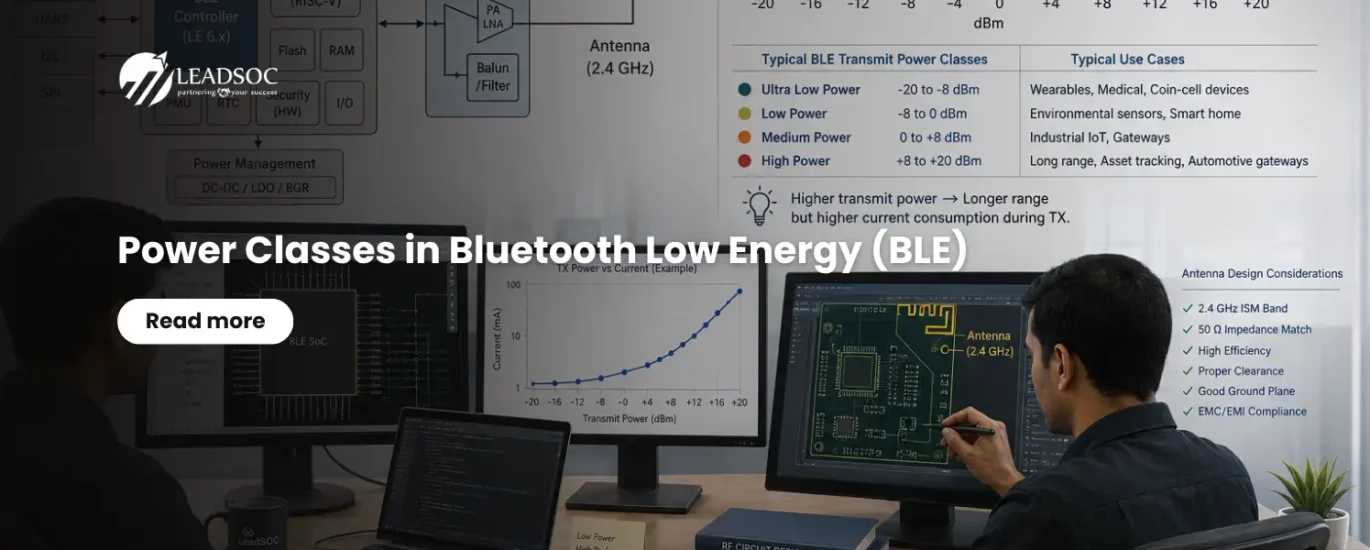
For practical engineering purposes, BLE transmit powers can be grouped into four categories, as summarized below.
| Power Category | Typical Range | Typical Applications |
|---|---|---|
| Ultra-low power | −20 dBm to −8 dBm | Wearable electronics, healthcare devices, battery-operated sensors with very short communication distances |
| Low power | −8 dBm to 0 dBm | Smart-home devices, environmental monitoring systems, indoor sensing |
| Medium power | 0 dBm to +8 dBm | Industrial IoT gateways, factory automation, larger coverage areas |
| High power | +8 dBm to +20 dBm | Long-range outdoor sensing, asset tracking, automotive gateway applications (where supported by hardware and regulations) |
The availability of programmable transmit power allows system designers to optimize wireless performance instead of relying on a single fixed transmitter power level.
Why Does BLE Need Different Power Classes?
At first glance, it may appear advantageous to configure every BLE device to transmit at the highest available RF power to maximize communication range. However, such an approach would significantly reduce battery life, increase electromagnetic interference, and create unnecessary congestion within the already crowded 2.4 GHz Industrial, Scientific, and Medical (ISM) frequency band.
Higher transmit power requires larger instantaneous current from the battery and generates stronger electromagnetic emissions. When many BLE devices operate simultaneously, unnecessarily high transmit power can interfere with nearby Bluetooth devices, Wi-Fi networks, Zigbee systems, Thread networks, and other wireless technologies sharing the same frequency spectrum.
Most BLE applications require communication over only a few meters. For example, wearable devices communicating with smartphones, room-temperature sensors communicating with gateways, or automotive cabin sensors communicating with a central controller rarely require maximum RF output power. Lower transmit power is therefore sufficient while simultaneously improving battery life and reducing interference.
Power classes enable designers to balance communication reliability with energy efficiency by selecting only the amount of RF power that is necessary for a given application.
BLE Power Classes and Energy Consumption
One of the most misunderstood aspects of BLE is the relationship between transmit power and battery life. Engineers often assume that doubling transmit power doubles battery consumption. In practice, the relationship is considerably more complex.
Increasing transmit power certainly increases the instantaneous current drawn by the radio transmitter. For example, a BLE radio transmitting at −20 dBm may consume only a few milliamperes during transmission, whereas transmitting at +8 dBm requires substantially higher current. Devices capable of transmitting at +20 dBm may require several tens of milliamperes or more while the transmitter is active.
However, BLE radios remain active only for extremely short intervals. Since the transmitter is inactive for well over 99 percent of the device's operating lifetime, the increase in average current consumption caused by higher transmit power is often much smaller than expected. Parameters such as advertising frequency, connection interval, packet retransmissions, processor wake-up time, and sensor sampling frequency often have a greater influence on battery life than transmit power alone.
Consequently, transmit power should always be optimized together with the communication schedule rather than treated as an independent parameter.
Link Budget is the Basis for Power Class Selection
Professional BLE system design relies on link-budget analysis rather than arbitrary selection of transmit power. A link budget estimates the signal strength that will be received after accounting for transmitter power, antenna characteristics, and propagation losses.
The received signal power depends on the transmitted RF power, the gain of both transmitting and receiving antennas, and the attenuation introduced by free-space propagation, walls, vehicle structures, human bodies, and other obstacles. Reliable communication is achieved only when the received signal remains comfortably above the receiver sensitivity of the BLE radio.
BLE receivers typically achieve sensitivities close to −95 dBm when operating with the standard 1 Mbps physical layer. When LE Coded PHY is employed for long-range communication, receiver sensitivities improve further, allowing significantly greater communication distances without increasing transmit power.
For this reason, many applications obtain better wireless performance by improving antenna efficiency, optimizing antenna placement, or selecting the LE Coded PHY instead of simply increasing RF output power.
Adaptive Transmit Power Control
Most BLE System-on-Chips incorporate dynamic transmit-power control mechanisms that automatically adjust RF output power according to communication quality. During operation, the receiver continuously measures the Received Signal Strength Indicator (RSSI), allowing the controller to determine whether communication margins are excessive or insufficient.
When two devices are physically close, the transmitter can safely reduce RF output power while maintaining reliable communication. As devices move farther apart or radio propagation conditions deteriorate, transmit power can automatically increase to preserve link quality.
This adaptive approach improves battery life, reduces interference, enhances coexistence with nearby wireless systems, and maintains consistent communication reliability without requiring manual configuration. Dynamic power control has become important in mobile systems such as wearable electronics and connected vehicles, where communication distances continuously change during operation.
Power Classes in Environmental Monitoring Applications
Environmental monitoring systems represent one of the largest application domains for Bluetooth Low Energy. Smart buildings, agricultural automation, weather stations, industrial process monitoring, water-quality measurement, and greenhouse management all rely heavily on BLE-enabled sensors for wireless data collection.
These sensing devices generally measure physical parameters such as temperature, humidity, pressure, carbon dioxide concentration, particulate matter, air quality, soil moisture, rainfall, light intensity, or water quality. Since environmental parameters typically change slowly, sensors usually transmit only a few bytes of information every several seconds or even every few minutes. The extremely low communication frequency allows battery-powered sensor nodes to achieve operational lifetimes extending over several years.
In most indoor monitoring applications, communication distances remain relatively short, making transmit powers between −8 dBm and 0 dBm sufficient. For outdoor agricultural deployments or smart-city infrastructure, where gateways may be located hundreds of meters away, designers often employ higher transmit powers together with BLE Long Range (LE Coded PHY) to improve coverage while still maintaining low average energy consumption.
The ability to select appropriate transmit power is therefore essential for achieving the optimum balance between battery life, communication reliability, and infrastructure cost.
Power Classes in Automotive Applications
Automotive systems present one of the most challenging wireless communication environments. Modern vehicles contain large metallic structures, multiple electronic control units, electric motors, high-current wiring harnesses, radar sensors, cameras, infotainment systems, Wi-Fi, cellular communication, Ultra-Wideband (UWB), GPS receivers, and numerous other radio-frequency sources that influence wireless signal propagation.
BLE is increasingly used within vehicles for applications including digital keys, smartphone connectivity, driver authentication, seat occupancy sensing, cabin environmental monitoring, predictive maintenance, tire-pressure accessories, trailer communication, driver health monitoring, and infotainment connectivity.
Unlike environmental monitoring systems, automotive applications prioritize communication reliability and functional safety over achieving the lowest possible transmit power. A temperature sensor located inside the passenger compartment may communicate reliably using transmit powers between −8 dBm and 0 dBm because the communication distance is only a few meters. Conversely, BLE gateways communicating with trailer electronics, external sensors, or vehicle access systems may require transmit powers of +4 dBm to +8 dBm, or higher where supported by the hardware, to overcome propagation losses caused by vehicle structures and varying operating conditions.
Modern automotive BLE systems also employ adaptive transmit-power control to continuously optimize RF output according to changing communication conditions. This minimizes unnecessary RF emissions while ensuring robust connectivity in highly dynamic vehicular environments. Careful transmit-power selection also contributes to improved coexistence with Wi-Fi, UWB, GNSS, cellular radios, and other wireless subsystems integrated within next-generation software-defined vehicles.
BLE 6.2 and Intelligent Power Management
Bluetooth Low Energy version 6.2 continues to improve the efficiency of wireless communication by enhancing protocol performance, reducing communication overhead, and improving radio management. Although BLE 6.2 does not redefine power classes, its improved protocol capabilities enable devices to exchange data more efficiently, thereby reducing overall active radio time.
Combined with adaptive transmit-power control, improved scheduling, optimized channel management, and intelligent connection management, BLE 6.2 enables battery-operated devices to maintain reliable communication while minimizing average energy consumption. These capabilities make BLE more suitable for automotive electronics, industrial IoT, and large-scale sensor networks where thousands of wireless devices may operate simultaneously.
Guidelines for Selecting BLE Power Classes
Selecting the appropriate BLE transmit power requires careful system-level analysis rather than simply choosing the highest available RF output. Designers should begin by estimating the maximum communication distance and performing a comprehensive link-budget analysis that considers antenna gains, enclosure losses, multipath fading, and environmental attenuation. A reasonable design margin should always be included to ensure reliable communication under worst-case operating conditions.
Transmit power should then be chosen as the minimum level that satisfies the required communication reliability. Lower transmit power not only reduces battery consumption but also minimizes interference with nearby wireless systems and simplifies electromagnetic compatibility compliance.
Whenever supported by the BLE controller, adaptive transmit-power control should be enabled to allow automatic optimization during operation. Engineers must carefully address antenna design, PCB layout, enclosure optimization, and RF matching networks, because improvements in antenna efficiency often produce greater communication benefits than increasing transmitter power.
Finally, comprehensive over-the-air testing under actual deployment conditions should be conducted to validate communication reliability before product release.
Comparative View of BLE Power Classes Across Applications
Different application domains require different transmit-power strategies depending on communication distance, environmental conditions, and reliability requirements. Wearable devices generally operate at ultra-low transmit powers to maximize battery life because communication occurs over only a few meters. Smart-home sensors and environmental monitoring systems typically use low transmit powers that provide reliable indoor coverage while enabling multi-year battery operation.
Industrial automation systems frequently require medium transmit powers because communication distances are larger and RF environments are more challenging. Automotive cabin electronics usually operate successfully with low transmit powers, whereas external vehicle communication systems, digital key infrastructure, trailer connectivity, and long-range asset-tracking applications may require medium or high transmit powers to achieve the required communication robustness.
This diversity clearly illustrates that there is no universally optimal BLE power class. The most suitable choice always depends on application requirements, communication range, deployment environment, and battery-life objectives.
Future Trends in BLE Power Management
The future of Bluetooth Low Energy lies in intelligent radio management rather than simply increasing transmitter capability. Emerging BLE devices are expected to incorporate artificial intelligence and machine-learning algorithms capable of predicting wireless channel conditions and proactively adjusting transmit power before communication quality degrades.
Future automotive platforms are likely to integrate BLE radio management with centralized wireless controllers that coordinate transmit power across Bluetooth, Wi-Fi, Ultra-Wideband, cellular, and vehicle communication networks. Intelligent antenna diversity, adaptive beam steering, and advanced coexistence algorithms will further improve wireless reliability while maintaining extremely low average energy consumption.
These developments will allow BLE to support increasingly sophisticated applications without compromising the low-energy operation that has made the technology successful across consumer, industrial, medical, and automotive markets.
Conclusion
Bluetooth Low Energy achieves its exceptional battery efficiency not because it always transmits at low RF power, but because it minimizes the amount of time the radio remains active. Power classes and Low Energy address two different aspects of wireless communication: Low Energy defines the protocol strategy that reduces average energy consumption, while power classes determine the RF transmit power used during each communication event.
Selecting the appropriate BLE power class is therefore a critical design decision that directly influences communication range, battery life, radio coexistence, electromagnetic compatibility, and overall system reliability. Environmental monitoring systems generally benefit from lower transmit powers because communication distances are short and battery life is the primary objective. Automotive applications, in contrast, often require adaptive or higher transmit-power settings to overcome complex propagation environments while maintaining robust and secure communication.
As BLE technology continues to evolve toward intelligent radio management and adaptive communication, transmit power will become an increasingly dynamic system parameter rather than a fixed configuration. Designers who understand the relationship between BLE Low Energy operation and RF power classes will be better positioned to design wireless products that simultaneously achieve long battery life, reliable connectivity, and compliance with the demanding requirements of next-generation IoT and automotive systems.
Enjoyed this article?
Subscribe to LeadSoC blogs for interesting high-tech practical articles.
Subscribe Now