Bluetooth Low Energy (BLE 6.2) Automotive SoC Architecture Using a RISC-V Processor
Engineering Insights · LeadSoC Technologies
The automotive industry is rapidly transitioning toward Software Defined Vehicles (SDVs), where intelligence is increasingly implemented in software rather than dedicated hardware. This transformation has created a significant demand for robust wireless connectivity solutions capable of supporting secure communication between Electronic Control Units (ECUs), sensors, smartphones, wearable devices, digital keys, battery management systems, and cloud infrastructure. Among various short-range wireless technologies, Bluetooth Low Energy (BLE) has emerged as one of the most widely adopted standards due to its excellent balance of low power consumption, reliable communication, mature ecosystem, and strong security framework.
Unlike consumer Bluetooth devices, automotive Bluetooth implementations must operate under stringent environmental conditions while satisfying demanding requirements for functional safety, cybersecurity, electromagnetic compatibility, deterministic communication latency, and long-term reliability. Modern BLE System-on-Chips are therefore no longer simple wireless transceivers but highly integrated mixed-signal devices that combine RF circuitry, digital baseband processing, embedded processors, hardware security accelerators, and automotive safety mechanisms.
The Bluetooth Low Energy 6.2 specification further enhances wireless efficiency through improvements in channel management, positioning accuracy, scheduling efficiency, coexistence mechanisms, and security enhancements. Combined with automotive safety standards such as ISO 26262 and cybersecurity regulations including ISO/SAE 21434 and UNECE R155/R156, BLE has become an attractive solution for connected vehicles.
This blog presents a processor-based Bluetooth Low Energy SoC architecture using a 32-bit RISC-V processor that supports the BLE 6.2 standard operating at a data throughput of 1 Mbps while incorporating all the essential safety, security, latency, and compliance requirements expected from an automotive-grade semiconductor.
Automotive Applications of Bluetooth Low Energy
Bluetooth Low Energy has become a key enabler for several automotive applications that require low-power wireless communication with deterministic response times. Passive Digital Keys allow drivers to unlock and start vehicles using smartphones or wearable devices without physical contact. Battery Management Systems increasingly use BLE for wireless diagnostics and health monitoring, while Tire Pressure Monitoring Systems rely on low-power wireless communication to periodically transmit sensor information.
Additional applications include infotainment pairing, wireless firmware updates, predictive maintenance, driver authentication, cabin sensing, seat occupancy detection, fleet management, wireless sensor networks, remote diagnostics, smart mirrors, and communication with wearable health monitoring devices. Each of these applications demands secure communication, low latency, reliable packet delivery, and immunity against electromagnetic interference typically encountered in automotive environments.
Bluetooth SoC Architecture
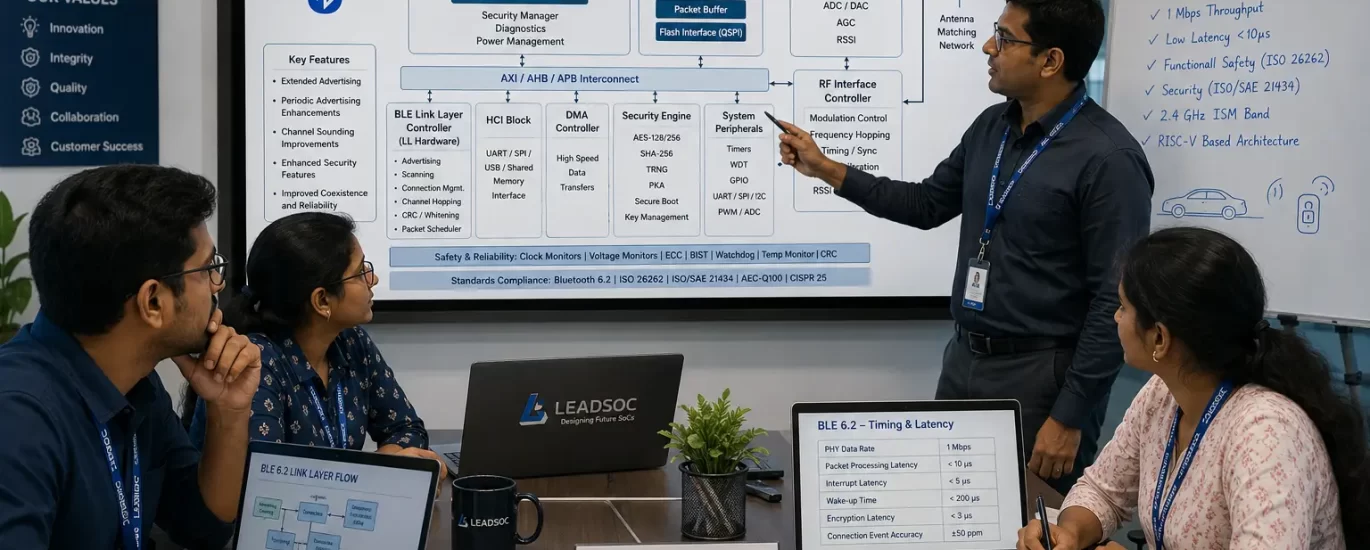
A modern automotive Bluetooth SoC integrates multiple hardware and software subsystems into a highly optimized architecture. At the center of the design resides a 32-bit RISC-V processor responsible for protocol stack execution, system management, diagnostics, security services, and application software. The processor communicates with the remaining hardware blocks through an AXI/AHB/APB interconnection network, enabling efficient access to memory, peripherals, and communication controllers.
The digital subsystem incorporates the BLE Data Link Layer controller, Host Controller Interface (HCI), DMA controller, timer subsystem, interrupt controller, memory interfaces, GPIO, UART, SPI, I²C peripherals, and security hardware accelerators. These components interact with the RF Interface Controller, which bridges the digital baseband with the analog RF front-end responsible for wireless transmission and reception.
The RF front-end comprises the frequency synthesizer, local oscillator, mixers, low-noise amplifier, power amplifier, ADCs, DACs, digital filters, automatic gain control circuitry, and antenna matching network, collectively enabling reliable communication over the 2.4 GHz ISM band.
RISC-V Processor Subsystem
The processor subsystem forms the controller of the Bluetooth SoC. A 32-bit RISC-V processor implementing the RV32IMC instruction set provides an excellent balance between computational performance, silicon area, and power consumption. The processor executes the Bluetooth Host stack, Real-Time Operating System, bootloader, firmware update manager, diagnostics software, and automotive application software.
The Bluetooth Host software manages Generic Access Profile (GAP), Generic Attribute Profile (GATT), Logical Link Control and Adaptation Protocol (L2CAP), Security Manager Protocol (SMP), and Host Controller Interface transactions. Besides protocol management, the processor is responsible for power management decisions, sleep scheduling, interrupt handling, communication with external automotive ECUs, health monitoring, and execution of functional safety diagnostics.
Depending on computational requirements, the processor typically operates between 80 MHz and 160 MHz, providing sufficient performance to meet BLE timing constraints while maintaining low energy consumption.
Memory Architecture
The processor interfaces with multiple memory types optimized for different purposes. A Boot ROM stores immutable secure boot firmware, while on-chip SRAM accommodates protocol stacks, application software, packet buffers, interrupt vectors, and runtime data structures. Dedicated secure memory stores cryptographic keys and device identity information, whereas external QSPI flash provides large-capacity firmware storage.
To improve reliability, automotive implementations employ Error Correcting Codes (ECC) for SRAM protection, ensuring single-bit error correction and multi-bit error detection during normal operation.
BLE RF Front-End
The RF front-end implements the analog circuitry required for wireless communication over the globally available 2.4 GHz Industrial, Scientific and Medical (ISM) band. The receiver path includes a Low Noise Amplifier that amplifies weak incoming signals while minimizing additional noise, followed by mixers that translate RF signals into intermediate frequencies for digital processing.
The transmitter chain employs a highly linear Power Amplifier capable of delivering adequate transmission power while satisfying stringent spectral emission requirements. Fractional-N PLL-based frequency synthesizers generate accurate carrier frequencies for all forty Bluetooth channels. Digital-to-Analog and Analog-to-Digital converters interface the analog and digital domains, while Automatic Gain Control continuously adjusts receiver sensitivity according to changing signal strengths.
Automotive RF subsystems must operate reliably under severe electromagnetic interference conditions and therefore incorporate sophisticated filtering, calibration, temperature compensation, and self-test capabilities to ensure consistent wireless performance.
RF Interface Controller
The RF Interface Controller block is the communication bridge between the digital BLE controller and the analog RF subsystem. This controller converts digital packet information into timing sequences required by the RF circuitry while simultaneously coordinating modulation, demodulation, frequency hopping, calibration control, and synchronization events.
The controller ensures that packet transmission begins exactly at scheduled connection events defined by the Bluetooth specification. Tight synchronization between digital scheduling logic and RF circuitry minimizes packet latency while maximizing communication reliability, particularly in automotive environments where deterministic behavior is essential.
BLE Data Link Layer Controller
The Data Link Layer controller forms the real-time communication engine of the Bluetooth SoC. Since Bluetooth communication involves strict timing requirements measured in microseconds, this controller is predominantly implemented as dedicated hardware rather than software executing on the processor.
The controller autonomously manages advertising events, scanning operations, connection establishment, channel hopping, packet scheduling, cyclic redundancy check generation, whitening, retransmission management, packet acknowledgments, supervision timers, encryption control, and synchronization with the RF subsystem. Hardware implementation significantly reduces processor workload while ensuring deterministic communication timing that satisfies BLE protocol specifications.
Host Controller Interface (HCI)
The Host Controller Interface establishes the standardized communication boundary between the Bluetooth Host software executing on the RISC-V processor and the underlying BLE controller hardware. Standardization of this interface allows Bluetooth protocol software to remain portable across different hardware implementations.
The HCI supports multiple transport mechanisms including UART, SPI, USB, shared memory interfaces, and virtual HCI implementations used during development and verification. Through standardized command packets, event notifications, and data transfer protocols, the HCI enables efficient communication while simplifying software maintenance and Bluetooth certification.
DMA Controller
High-speed packet transfers between memories and communication peripherals are handled by the Direct Memory Access controller. Instead of relying on the processor for every data movement, the DMA autonomously transfers BLE packets between RF buffers, Link Layer memory, SRAM, and communication interfaces.
By eliminating unnecessary processor intervention, DMA substantially reduces interrupt overhead, lowers power consumption, and improves overall communication throughput.
Hardware Security Engine
Security has become one of the most important aspects of automotive wireless communication. Modern Bluetooth SoCs therefore incorporate dedicated hardware accelerators that execute cryptographic algorithms significantly faster and more efficiently than software implementations.
The security subsystem typically includes AES-128 and AES-256 encryption engines, SHA-256 hashing accelerators, True Random Number Generators, Public Key Cryptography accelerators, secure key storage, secure boot logic, firmware authentication hardware, lifecycle management, debug authentication, and tamper detection circuitry.
These hardware accelerators ensure secure pairing, encrypted communication, authenticated firmware updates, and protection against unauthorized software execution while minimizing latency during cryptographic operations.
Functional Safety Architecture
Automotive electronics must continue operating safely even when hardware faults occur. Consequently, Bluetooth SoCs incorporate numerous diagnostic mechanisms that continuously monitor the health of internal hardware components.
Clock monitoring circuitry detects frequency deviations, voltage monitors identify abnormal power supply conditions, watchdog timers supervise processor execution, while Built-In Self-Test mechanisms periodically verify memories, logic blocks, and RF circuits. Temperature sensors monitor thermal conditions, PLL lock detectors ensure stable clock generation, and CRC monitors verify communication integrity.
These safety mechanisms support compliance with ISO 26262 functional safety requirements and enable early detection of hardware faults before they compromise system operation.
Automotive Cybersecurity
Automotive cybersecurity has evolved into a mandatory design requirement rather than an optional feature. Bluetooth SoCs must therefore comply with ISO/SAE 21434 and UNECE cybersecurity regulations by incorporating hardware Root of Trust, secure boot mechanisms, authenticated firmware updates, anti-rollback protection, secure debug interfaces, protected cryptographic key management, device authentication, and secure lifecycle management.
Together, these features establish multiple layers of defense against malicious software, unauthorized firmware modifications, and cyberattacks targeting connected vehicles.
Clock Architecture
Meeting Bluetooth timing requirements depends heavily on carefully designed clock architecture. A low-frequency 32.768 kHz crystal oscillator maintains accurate timing during deep sleep modes with minimal power consumption. A precision 32 MHz crystal provides the primary reference clock required by the BLE baseband controller, while the RF synthesizer generates carrier frequencies within the 2.4 GHz ISM band.
The RISC-V processor typically operates between 80 MHz and 160 MHz depending on workload, while peripheral buses operate at approximately 80 MHz. Careful clock synchronization and low-jitter clock generation ensure that packet transmission, reception, frequency hopping, and encryption occur within the strict timing limits defined by the Bluetooth specification.
Throughput and Latency Considerations
The proposed architecture targets the standard BLE 1 Mbps physical layer, which offers the optimal trade-off between communication range, power consumption, and reliability for automotive applications. Dedicated hardware acceleration ensures deterministic, low-latency operation suitable for automotive control systems while maintaining compatibility with BLE 6.2 requirements.
| Parameter | Target Value |
|---|---|
| Physical layer data rate | 1 Mbps (BLE 1M PHY) |
| Packet processing latency | Below 10 microseconds |
| Interrupt response time | Below 5 microseconds |
| Wake-up time | Under 200 microseconds |
| Hardware-assisted encryption latency | Less than 3 microseconds |
Automotive Standards Compliance
Designing an automotive Bluetooth SoC requires simultaneous compliance with multiple international standards. Bluetooth SIG certification verifies interoperability with the Bluetooth 6.2 specification, while ISO 26262 governs functional safety. Cybersecurity requirements are addressed through ISO/SAE 21434 together with UNECE R155 and R156 regulations governing cybersecurity management and secure software updates. Automotive semiconductor qualification follows AEC-Q100, whereas electromagnetic compatibility is ensured through compliance with CISPR 25 and ISO 11452.
| Standard | Scope |
|---|---|
| Bluetooth SIG (BLE 6.2) | Protocol interoperability and certification |
| ISO 26262 | Functional safety |
| ISO/SAE 21434 | Cybersecurity engineering |
| UNECE R155 / R156 | Cybersecurity management and secure software updates |
| AEC-Q100 | Automotive semiconductor qualification |
| CISPR 25 / ISO 11452 | Electromagnetic compatibility (EMC) |
Meeting these standards requires coordinated development across architecture, RTL design, embedded software, RF engineering, verification, physical implementation, DFT, manufacturing test, and system validation teams.
Verification Strategy
A comprehensive verification methodology is essential for ensuring protocol correctness, hardware reliability, safety compliance, and cybersecurity robustness. Functional verification validates the RISC-V processor, BLE Link Layer, DMA controller, HCI, RF interface, and security blocks using UVM-based verification environments. Protocol compliance testing verifies interoperability against Bluetooth SIG qualification suites, while RF co-simulation confirms modulation accuracy, receiver sensitivity, channel hopping behavior, and coexistence performance.
Functional safety verification includes fault injection campaigns to evaluate diagnostic coverage, watchdog behavior, ECC correction, and Built-In Self-Test functionality. Security verification validates secure boot, firmware authentication, cryptographic accelerators, key management, anti-rollback protection, and debug authentication. Finally, system-level validation confirms reliable operation with automotive ECUs, smartphones, digital keys, wireless sensors, and production test equipment under realistic environmental conditions.
Conclusion
Bluetooth Low Energy has become indispensable wireless technology for next-generation connected and software-defined vehicles. A modern automotive BLE SoC extends far beyond conventional wireless communication by integrating a RISC-V processor, deterministic Link Layer hardware, advanced RF circuitry, dedicated security accelerators, comprehensive safety diagnostics, and standardized host interfaces into a single highly integrated semiconductor device.
Supporting BLE 6.2 at a 1 Mbps data rate while complying with Bluetooth SIG certification, ISO 26262 functional safety, ISO/SAE 21434 cybersecurity, AEC-Q100 qualification, and automotive EMC standards requires a carefully engineered architecture that balances performance, power efficiency, reliability, and security.
Let's Build Your Next SoC
At LeadSoC Technologies, our engineering teams bring deep expertise in SoC integration, enabling customers to successfully develop and deploy solutions from concept to silicon.
Subscribe to LeadSoC Blogs