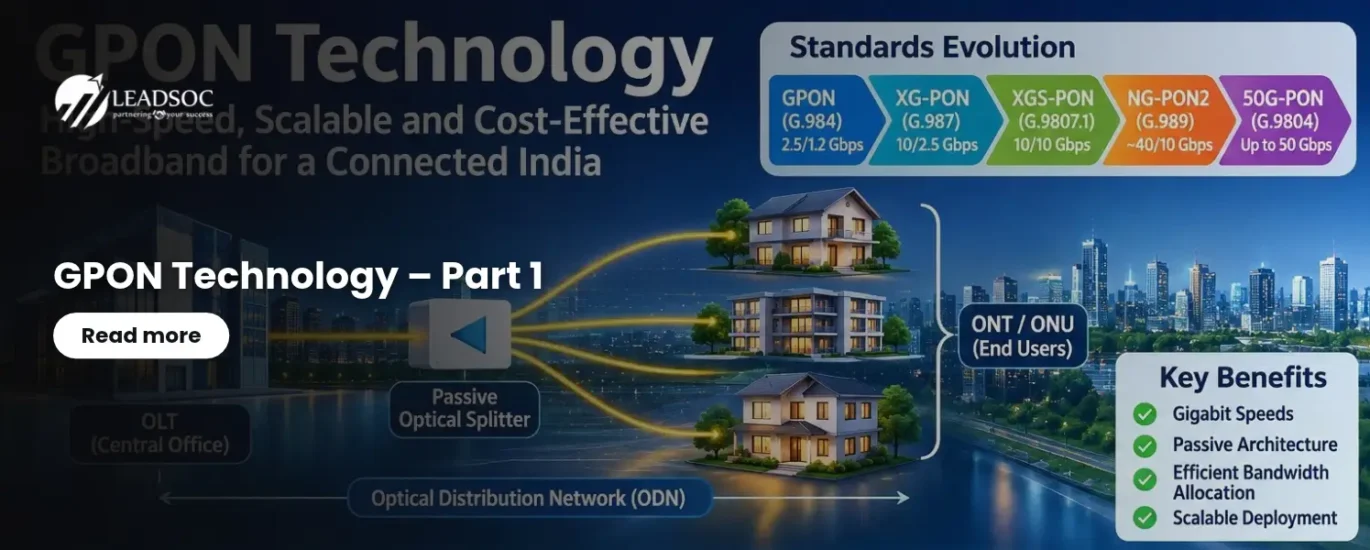
GPON Technology Part-1
Optical Access Networks · ITU-T Standards · OLT/ONT/ODN Architecture
The demand for high-speed internet connectivity has increased significantly with the growth of cloud computing, video streaming, artificial intelligence, smart cities, industrial automation, and connected devices. Traditional copper-based communication networks are increasingly finding it difficult to meet the bandwidth, reliability, and scalability requirements of modern communication infrastructure.
Optical fibre communication provides an effective solution by transmitting information as light over fibre-optic cables. Among the technologies developed for broadband access networks, Gigabit Passive Optical Network (GPON) has emerged as one of the widely deployed solutions for delivering high-speed broadband services to homes, offices, and enterprises.
GPON is a fibre-optic access technology standardised by the International Telecommunication Union – Telecommunication Standardization Sector (ITU-T). It enables a single optical fibre from a service provider's central office to serve multiple subscribers through passive optical components such as optical splitters.
Unlike conventional point-to-point fibre connectivity, GPON uses a point-to-multipoint architecture. This reduces the amount of fibre and active equipment required in the access network, making it economical for large-scale broadband deployment.
This is the first of a two-part LeadSoC blog series on GPON. Part 1 covers GPON fundamentals, ITU-T standards and their evolution, communication principles, system architecture, and the major hardware and software blocks involved. Part 2 will cover the GPON solutions and product ecosystem, the companies active in India's GPON landscape, applications, semiconductor design opportunities, a conceptual OLT SoC architecture, and India's deployment and future opportunities.
1. GPON Technology Fundamentals
GPON stands for Gigabit Passive Optical Network. It is a fibre-optic broadband access technology that connects a service provider's network to multiple end users using a shared optical distribution network.
The word passive is important. The optical distribution network between the service provider's central office and the subscribers does not require electrically powered switching or amplification equipment. Instead, it uses passive optical splitters to distribute optical signals.
A typical GPON network consists of three major elements:
- Optical Line Terminal (OLT): Located at the service provider's central office. It controls communication with multiple subscribers and interfaces with the service provider's core network.
- Optical Network Terminal (ONT) or Optical Network Unit (ONU): Installed at the subscriber's premises or at a suitable distribution point. It converts optical signals into electrical interfaces such as Ethernet, Wi-Fi, voice, and other services.
- Optical Distribution Network (ODN): The fibre-optic infrastructure connecting the OLT and ONTs through optical splitters, connectors, and fibre cables.
The fundamental idea is to share the optical transmission capacity of one fibre among multiple subscribers. For example, a single OLT port can serve 32, 64, or sometimes 128 ONTs, depending on the optical budget, splitter configuration, and network design.
GPON supports downstream transmission at approximately 2.488 Gbit/s and upstream transmission at approximately 1.244 Gbit/s. The downstream and upstream channels use different wavelengths, allowing bidirectional communication over the same fibre.
2. GPON Standards and Technology Evolution
The ITU-T has developed several standards to support the evolution of passive optical networks. These standards define the physical transmission characteristics, communication protocols, management mechanisms, and interoperability requirements.
| Standard | Technology | Nominal Downstream | Nominal Upstream |
|---|---|---|---|
| ITU-T G.984 | GPON | 2.488 Gbit/s | 1.244 Gbit/s |
| ITU-T G.987 | XG-PON | 9.953 Gbit/s | 2.488 Gbit/s |
| ITU-T G.9807.1 | XGS-PON | 9.953 Gbit/s | 9.953 Gbit/s |
| ITU-T G.989 | NG-PON2 | Multiple wavelengths; approx. 40 Gbit/s aggregate | Multiple wavelengths; approx. 10 Gbit/s aggregate |
| ITU-T G.9804 series | 50G-PON | Up to 50 Gbit/s class | Depends on the specified upstream configuration |
The GPON family is defined through a set of related recommendations:
- G.984.1 – General characteristics: Defines the overall GPON architecture, network configurations, reach, and service requirements.
- G.984.2 – Physical Media Dependent (PMD) layer: Defines optical transmission characteristics, wavelengths, line rates, and optical interface requirements.
- G.984.3 – Transmission Convergence (TC) layer: Defines framing, multiplexing, upstream bandwidth allocation, ranging, activation, and error correction.
- G.984.4 – Management: Originally defined ONT management and control interface requirements; subsequent management specifications evolved into G.988.
- G.984.5 – Enhancement bands: Addresses wavelength coexistence with other optical access technologies.
- G.988 – ONT Management and Control Interface (OMCI): Defines how the OLT manages and configures ONTs.
For the next generation of optical access networks, XG-PON (G.987) increases downstream capacity to approximately 10 Gbit/s while retaining a lower upstream rate. XGS-PON (G.9807.1) provides approximately 10 Gbit/s in both directions and is relevant for enterprise broadband, business connectivity, mobile backhaul, and high-bandwidth residential applications.
NG-PON2 (G.989) uses multiple wavelengths to increase aggregate network capacity and support flexible bandwidth allocation. The 50G-PON family (G.9804 series) represents a further evolution towards higher-capacity access networks.
The selection of a particular standard depends on subscriber density, bandwidth requirements, optical infrastructure, equipment cost, and the service provider's upgrade strategy.
3. GPON Communication Principles
GPON uses wavelength division multiplexing to transmit upstream and downstream information over a common optical fibre. The two directions use different optical wavelengths.
| Communication Direction | Typical Wavelength | Data Rate |
|---|---|---|
| Downstream – OLT to ONT | 1490 nm | 2.488 Gbit/s |
| Upstream – ONT to OLT | 1310 nm | 1.244 Gbit/s |
An optional 1550 nm wavelength can be used for RF video overlay in suitable network configurations.
Downstream Communication
The OLT transmits information to all connected ONTs through the optical splitter. Each ONT identifies and accepts the traffic intended for it using logical identifiers and the GPON framing mechanism. This is similar to a broadcast communication system, where multiple subscribers receive the transmitted optical signal but process only their intended data.
Upstream Communication
Upstream communication is more complex because multiple ONTs share the same optical fibre towards the OLT. If two ONTs transmit simultaneously without coordination, their optical signals may collide.
GPON avoids this through Time Division Multiple Access (TDMA). The OLT allocates specific time slots to individual ONTs using Dynamic Bandwidth Allocation (DBA). Each ONT transmits only during its allocated time slot. The OLT coordinates these transmissions to ensure that the signals arrive without interfering with one another.
Dynamic Bandwidth Allocation
DBA is an important feature of GPON. The OLT monitors the bandwidth requirements of different subscribers and dynamically allocates upstream transmission capacity. This helps improve bandwidth utilisation when subscriber traffic varies throughout the day.
4. GPON System Architecture
A typical GPON deployment can be understood by dividing it into three sections: the central office, optical distribution network, and subscriber premises.
4.1 Central Office – Optical Line Terminal
The OLT is the central controlling equipment of the GPON network. It connects the service provider's core network to multiple optical subscriber connections. Its major functions include:
- Optical transmission and reception.
- GPON framing and protocol processing.
- Downstream traffic broadcasting and upstream TDMA scheduling.
- Dynamic bandwidth allocation.
- ONT registration, activation, and authentication.
- Quality of Service (QoS) management.
- Traffic classification and service provisioning.
- Network monitoring, fault management, and performance reporting.
An OLT generally contains multiple line cards, with each line card supporting one or more GPON ports. Each port connects to a group of subscribers through the optical distribution network.
4.2 Optical Distribution Network
The ODN is the passive optical infrastructure between the OLT and the ONTs. It consists of single-mode optical fibre cables, optical splitters, connectors, patch panels, and distribution enclosures.
A typical GPON port can support a 1:32 or 1:64 optical split. Higher split ratios, including 1:128, may be supported depending on the equipment and optical link budget.
For example, consider a service provider deploying a GPON network for 64 houses in a residential community. One OLT port can connect to a 1:64 optical splitter. The splitter distributes the optical signal to 64 individual ONTs installed in the houses.
The optical splitter does not require power or electronic control. This is one of the reasons GPON is economical for large-scale deployment. However, the number of subscribers alone does not determine the achievable bandwidth. The available line capacity is shared among active subscribers, and actual user throughput depends on service provisioning, traffic load, and network overhead.
4.3 Subscriber Premises – ONT/ONU
The ONT is the endpoint of the optical network at the subscriber's premises. It converts optical signals into electrical signals and provides interfaces for end-user equipment. A typical ONT may support:
- Gigabit Ethernet ports for wired connectivity.
- Wi-Fi interfaces for wireless broadband.
- Voice interfaces for telephone connectivity.
- IPTV and video interfaces.
- Multiple LAN connections.
- Management and monitoring interfaces.
An ONU generally refers to an optical network unit that may be deployed at locations such as buildings, cabinets, or distribution points. An ONT is commonly used for the termination equipment installed at the end-user premises.
4.4 GPON Protocol Stack
The GPON protocol stack is another important part of the architecture. Its major functional layers are:
- Physical Media Dependent (PMD) layer: Handles optical transmission, reception, wavelength characteristics, signal power, and physical-layer parameters.
- Transmission Convergence (TC) layer: Handles GPON framing, encapsulation, multiplexing, ranging, bandwidth allocation, and error correction.
- GPON Encapsulation Method (GEM): Provides a mechanism for carrying different types of user traffic over the GPON transport infrastructure.
- ONT Management and Control Interface (OMCI): Enables the OLT to configure, monitor, and manage the ONT.
Ethernet, voice, and other service traffic are mapped into the GPON transport structure and delivered to their respective destinations. This separation of functions makes GPON a combination of optical hardware, digital communication processing, embedded software, and network management.
5. Major Hardware and Software Blocks
From an engineering perspective, GPON equipment consists of several functional blocks.
| Functional Block | Main Responsibility |
|---|---|
| Optical Transceiver | Optical transmission and reception |
| Burst Mode Receiver | Receives upstream optical bursts from different ONTs |
| Laser Driver | Controls the optical transmitter |
| GPON MAC | Implements GPON protocol and framing functions |
| Traffic Scheduler | Manages upstream bandwidth allocation |
| Ethernet Switch | Handles Ethernet traffic switching |
| Network Processor | Performs packet processing and traffic management |
| Embedded Processor | Runs control software and management functions |
| Memory Subsystem | Stores firmware, configuration, and packet buffers |
| Power Management | Provides regulated power to electronic blocks |
| Clock and Reset | Provides timing and system initialisation |
| Management Interface | Supports configuration, monitoring, and diagnostics |
The optical transceiver is a particularly important component. It interfaces the electronic system with the optical fibre. In the OLT, the upstream receiver must handle burst-mode optical signals arriving from different ONTs. These signals may have different optical power levels and arrival times. The receiver must rapidly recover the signal and clock information for each incoming burst.
This is different from a conventional continuous-mode optical receiver and is an important design consideration. In the ONT, the upstream transmitter is controlled to transmit only within the time slots allocated by the OLT. The GPON MAC and associated digital logic implement the protocol, framing, traffic scheduling, and data handling.
Stay Connected with LeadSoC
Subscribe to LeadSoC's practical technology blogs to explore more about semiconductor design, SoC architectures, communication technologies, and AI-enabled chip development.
Subscribe Now